
• +385 (0) 52 662 343
  • This email address is being protected from spambots. You need JavaScript enabled to view it.

Capture your scene

Each view of Buzet is an image you wish to capture in a photograph and cherish.


... the Old Town, Large Gate (Vela vrata) and Large Well (Vela šterna), its winding paths that lead to hidden corners ending on the horizon. Capture your scene while bike riding and exploring its surroundings rich in history...

Feel the touch of pleasure and delight,
health, beauty and vitality.

Dare and choose

... hang gliding or free climbing, paragliding or horse riding, mountain biking or trekking...

OUTDOOR SPORTS

Relax


Relax, be romantic. Indulge yourself. Happiness here lies in small things. It’s up to you to discover it.

  • Glagolitic Lane
  • Glagolitic Lane
  • Glagolitic Lane
  • Glagolitic Lane

A significant and exceptional monument complex commemorating Glagolitic heritage was erected in 1977 along the road from Roč to Hum. The Glagolitic Lane is a project of the Chakavian Parliament (Čakavski sabor). The author of the entire concept is Zvane Črnja, and it was realized through the work of prof. dr. Josip Bratulić and sculptor Želimir Janeš. The beginning of the Lane is at the foot of Roč hill with the first monument – Pillar of the Chakavian Parliament.
This monument in the form of the Glagolitic letter S symbolizes the first Slavic script and the beginnings of Slavic literacy. The remaining ten memorial sites are: Table of Cyril and Methodius, Chair of Kliment of Ohrid, Belvedere of Gregory of Nin, Glagolitic Lapidarium, Gorge of the Croatian Lucidar, Gradient of the Survey of Istrian Land Boundaries, Wall of Croatian Protestants and Heretics, Resting-area of Juri the Deacon, Monument of Resistance and Freedom and Hum Gates.

The glagolitic memorial-sites:

Pillar of the Chakavian Parliament – a memorial-site in the shape of the glagolitic letter S which symbolizes the first Slavic script and the beginnings of the Slavic literacy.

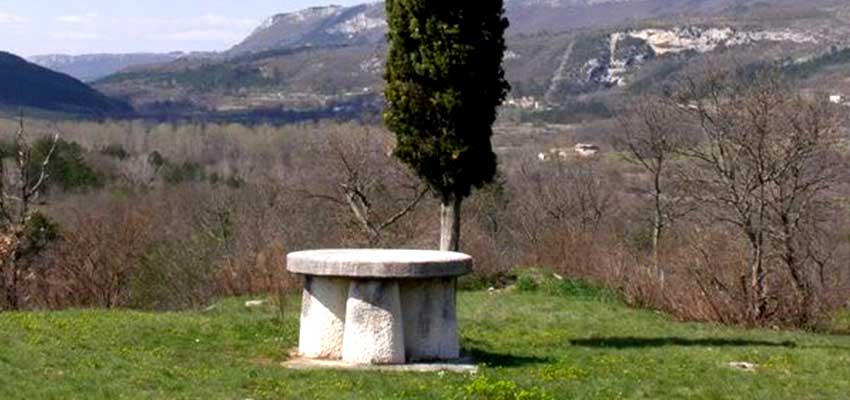
Table of Cyril and Methodius – the name of this stone table monument is written on the rim written in Latin, Cyrillic and Glagolitic. Two cypresses are planted beside to the table symbolizing the Holy Brothers.

The Chair of Kliment of Ohrid – dedicated to Kliment of Ohrid, the most meritorious disciple of Cyrill and Methodius the founder of the first Slavic university.

Glagolitic Lapidarium – a collection of copies of the oldest and most significant Glagolitic inscriptions fom Istra, the Kvarner islands and Dalmatia are built in the surrounding wall in front of the church in the village Bernobići.

Gorge of the Croatian Lucidar – dedicated to the Croatian Lucidar, the medieval encyclopedia used by our Glagolites.

Belvedere of Grgur of Nin – the Latin, Glagolitic and Cyrillic alphabets are inscribed on the stone block.

Gradient of the Survey of Istrian Land Boundaries – The Survey of Istrian Land Boundaries is a collection of documents from the 13th and 14th centuries about land boundaries of Istrian feudal lords: Aquilean Patriarchate, Pazin county and Venice. The memorial-site consists of stone blocks cut in the shape of Galgolitic letters which put together give the original name: Istarski razvod.   

Wall of the Croatian Protestants and Heretics – in the centre of the stone wall, in the white stone block, the Galgolitic letter S is inscribed whereas in its upper part are names of famous Croatian protestants and heretics. Quotations from their works are inscribed in the seven stone slabs.

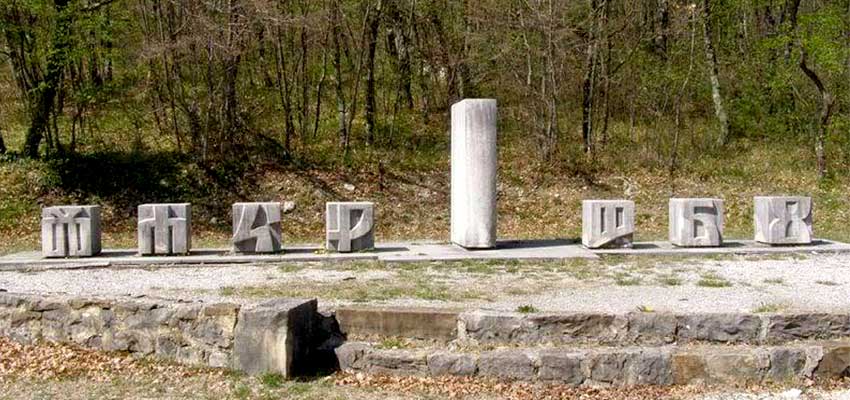
Resting-place of Juri the Deacon – dedicated to Juri the Deacon, an Istrian Galgolite who helped prepare the printing of the first Croatian printed book Missal from 1483. He enthusiastically announced it in Duke Novak's Missal (written in 1386) with words which are inscribed in the stone wall (in the shape of a book). The seven stone cubes resemble matrixes for hand typesetting while the letters on them spell: Žakn Juri (Juri the Deacon).

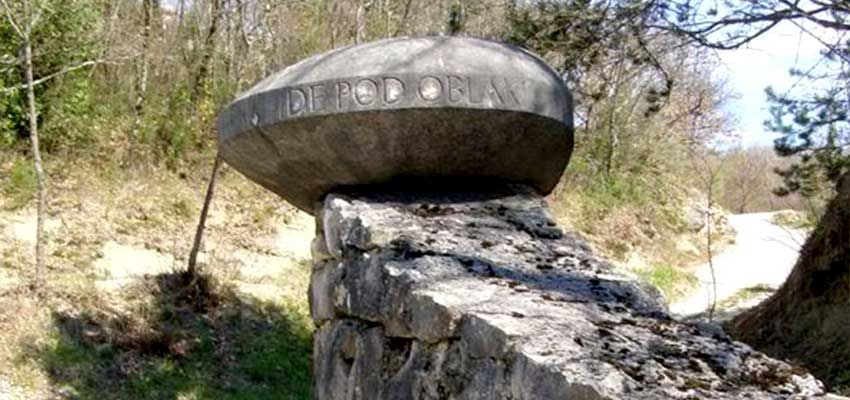
Monument to Resistance and Freedom – it consists of three stone blocks, one above the other. Each block symbolizes a particular historic period: the ancient world, the Middle Ages and the modern world. They symbolize the resistance of the people of Hum and its area against tyranny and banishment as well as their aspiration to peace and freedom throughout the ages.

Gate of Hum – made of copper hand-holds in the shape of ox's horns, the two door knockers bear welcome inscriptions. There is a peasant's calendar - twelve medallions with scenes of rural life – placed semi-circularly in the upper part of the gate.

(Text by Miroslav Sinčić)

Glagolitic monuments

Some of the oldest Glagolitic monuments - inscriptions, graffiti, codices - have been found on the territory of Istria. Among them is the Plomin Inscription from the 11th century and Grdoselo Fragment from the 12th century. These are two Glagolitic inscriptions on stone that are the basis of Glagolitic research in Istria.
The Buzet area Buzeština, especially around Roč, Hum, Sovinjak and Buzet abounds in Glagolitic monuments.

These are some of the most significant ones:

HUM GRAFFITO (HUMSKI GRAFIT)


Source: Cvergla blog

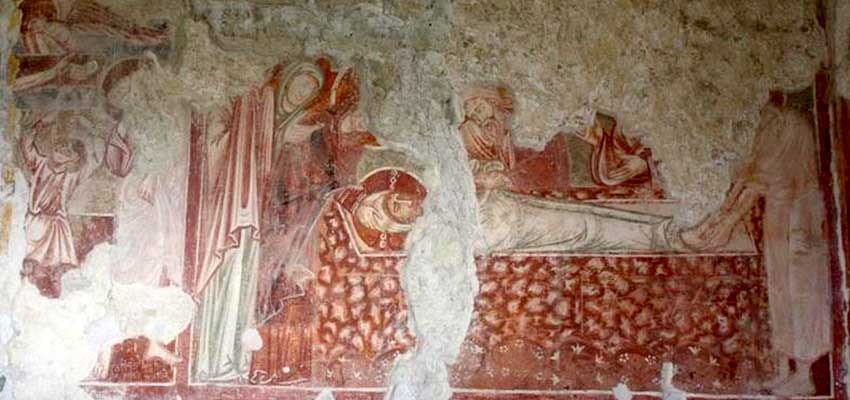
On the painted walls of the small church of St. Jerome at the Hum cemetery are about 40 inscribed Glagolitic graffiti. Most of them date from the 12th - 15th century. The oldest among them is surely the Hum graffito from the second half of the 12th century. It is inscribed on a red rim on the right side of the apse and reads (transcribed): For Martin the Blacksmith are all 30; yet one more is for him.
This is how an unknown Glagolitic priest from Hum registered the number of offered so-called Gregorian masses for Martin the Blacksmith.

HUM GLAGOLITIC INSCRIPTIONS (HUMSKI GLAGOLJSKI NATPISI)
Of the eight famous Glagolitic inscriptions from Hum, one was written on paper (pasted onto the Hum triptych) and one on the church bell (lost), whereas the others were inscribed in stone.

BREVIARY OF VID OF OMIŠALJ (BREVIJAR VIDA OMIŠLJANINA)
Liturgical codex commissioned for St. Bartholomew's church in Roč.

ROÈ MISSAL (ROČKI MISAL)
Dates from the 15th century and today is kept in the National Library in Vienna (Austria). It was probably written by Bartol Krbavac.

DUKE NOVAK'S MISSAL (MISAL KNEZA NOVAKA)
Dates from 1368, and was bought for the church in Nugla near Roè in 1405. That missal served as a model for the first Croatian printed book -  Missal from 1483 - Editio priceps. Although the place of printing is unknown, a well-known fact is that the printing of the book was prepared by Istrian Glagolitic priests, and among them was Juri the Deacon from Roč.

NOTEBOOK OF SPIRITUAL LAWS (KVADRIGA DUHOVNIM ZAKONOM), EXPLANATION OF SUFFERING (TLMAČENJE MUKI) and KVAREZIMAL
These are three works translated, transcribed and adapted by Šimun Greblo, the well-known Glagolitic priest at the end of the 15th century.


  • Regional museum
  • Regional museum
  • Regional museum

The museum was founded in 1961 and until 1975 functioned as an independent institution. From the very beginnings it has preserved its features of a regional or municipal museum, so most of the exhibits have been collected in the Buzet area.
The Regional Museum is housed in the Bigatto Palace in the old town dating from 1639.  It houses a permanent display of archaeological stone monuments, ethnographic collection and gallery for organizing art exhibitions and concerts. There are also exhibitions entitled "Anti-fascist battle in the Buzet area" and "Petrapilosa Castle – traces of frescoes from the chapel of St. Mary Magdalene".
Within the museum complex is a hall for temporary exhibitions, arts and crafts workshops, as well as library and photograph archives. One of the most interesting museum exhibits is the Buzet earring.


Opening hours - July and August: 

Mon - Fri  9am - 3pm, 5pm - 8pm
Saturday and Sunday 9am - 12am, tel. 00385 52 662-792 or e-mail: This email address is being protected from spambots. You need JavaScript enabled to view it.

Admission: adults – 15.00 kn, children and groups – 10.00 kn.

Old craftsmen workshops
Visit one of the preserved old craftsmen workshops of the Regional Museum of the City of Buzet.

Comb-making trade
Contains a hand-operated machine for making combs made of horns of the typical Istrian ox boškarin, needed tools and products. It is the only comb-making shop of this kind in Istria.

Blacksmith and wagon maker's trade
contains original tools and products of the blacksmith and wagon maker's shop, situated in the onetime town blacksmith's shop.

Old town bakery
Located in the authentic building with original baker's oven where bread and other products were once baked.


  • Divine glagolitic

Words inscribed in the stone and the parchment follow this part of Istria, live with it in the new discoveries. The glagolitic Alphabet left a deep trace in Istria, in the Croatian coastal area and on the islands. The role of the custodian of the Alphabet belonged to the church, tofraternities, unknown writers: parochs, community leaders and notaries. The Glagolitic Alley, the monument of the Glagolitic Literature history from brothers Ćiril and Metoda to our days, preserve the knowledge of the giants. The stone inscriptions lead our today`s travels and path starts beneath Roči n the shape of the letter S – the symbol of the čakavski sabor…


  • Church of the Holy Spirit

This small church is the most interesting sacral structure in the Buzet area, since it is defined by three periods and phases of construction. The rectangular Romanesque nave was built first, then the late-Romanesque presbytery was added on the eastern side. The apses reveal lovely Gothic windows with pointed upper parts, elaborate features and original glass which is rarely seen in Istria.
In the third phase of construction the Renaissance sacristy was added on the southern side. During the 17th century a large Baroque portico (lopica) with an unusual ground plan and fan-shaped ceiling was built. One of the interesting details from the church interior is surely the presbytery with radiating vault. It is a unique example of this type in the entire region.